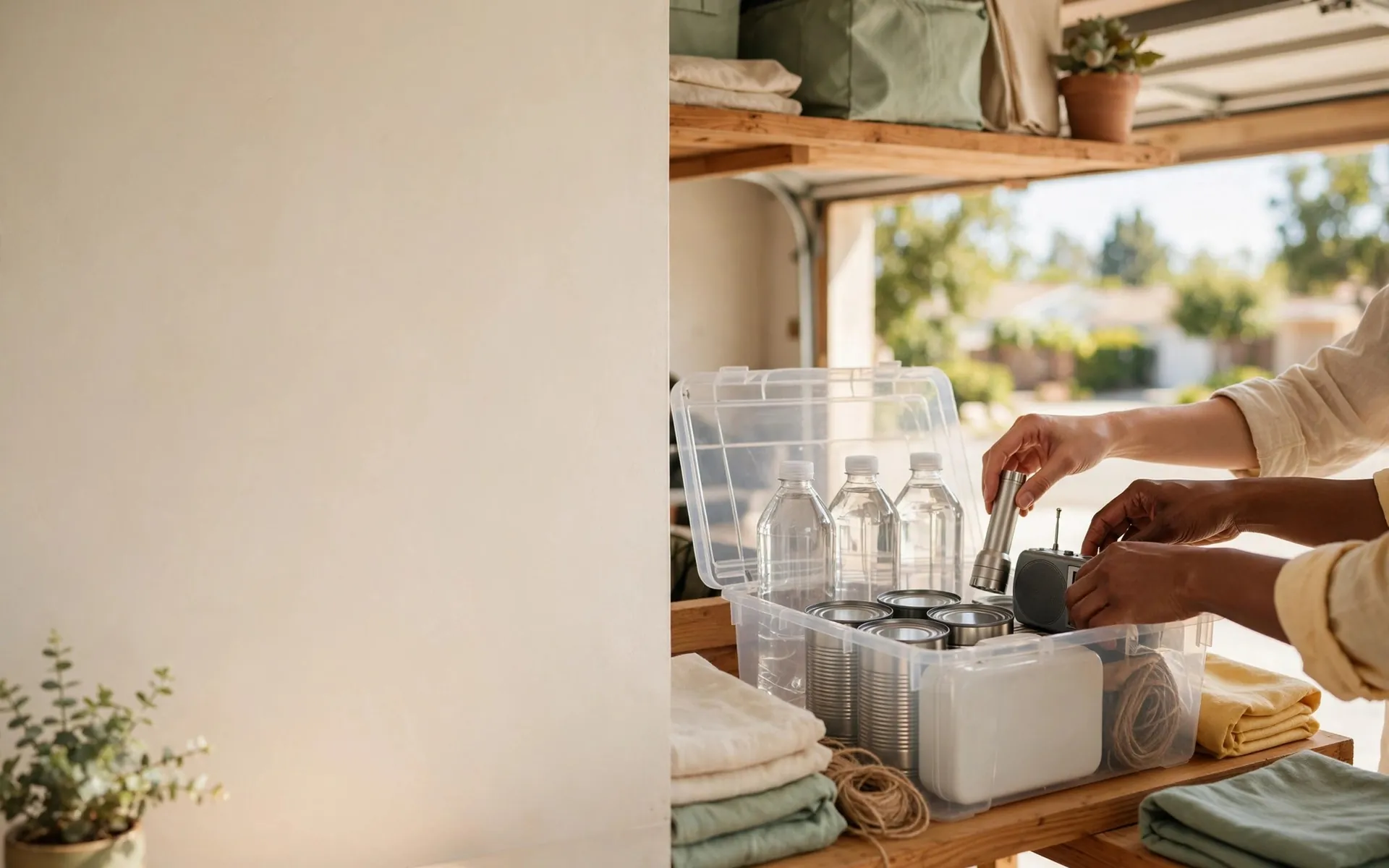
72-hour kit
Building your 72-hour family kit
Seventy-two hours is the window official guidance plans around: after a major earthquake, fire or storm, help can take about three days to reach every street. The kit is what gets a household through that window without a trip to a store that may be closed. It is not a bunker project. Most families already own two thirds of it, and the rest costs less than a week of groceries.
This article is the long version. The one-page version, with a tile for each category, is the 72-hour family kit guide, and the whole thing comes bundled in the free 72-Hour Readiness Plan.
Start with water, because everything else waits on it
One gallon per person per day, for three days. A family of four needs twelve gallons: that is about two cases of bottled water plus a jug, or three of the seven-gallon containers that stack in a garage. Half of it is for drinking; the other half is for cooking, washing hands and flushing.
Store-bought bottles are the easiest start because they are sealed, dated and stackable. Rotate them every six months, when the clocks change. If you have pets, add a gallon a day for a large dog and less for small animals.
If water is ever shut off, the tank of a standard water heater holds drinkable water, and the bathtub filled early flushes toilets for days. Both are covered in the week without power guide.
Food that needs no cooking
Three days of what your family actually eats, not survival rations nobody wants. Bars, nut butter, crackers, canned fruit and beans, tuna, applesauce, dry cereal, shelf-stable milk. The test is simple: could a tired parent feed two kids from this bin in the dark with no stove? Add a manual can opener and a spoon per person, and you are done.
Freeze-dried buckets are fine later, once the basics exist. They are the expensive extra most new preppers buy first and eat never.
Light, news and power
- A flashlight per person and a lantern for the room everyone ends up in. LED, with the batteries in them, and a spare set in a sealed bag.
- A headlamp for whoever is doing the work, so both hands are free.
- A battery or hand-crank radio for news when the cell towers are overloaded.
- Power banks, charged, one per phone. A small portable power station is the next step up and runs a lamp, phones and a CPAP overnight; it is worth more than a generator for most households, as the backup power guide explains.
Candles do not belong in the kit. They start house fires during outages every year.
First aid and medications
A real first aid kit, plus pain reliever and an antihistamine. Then the part people miss: seven days of every prescription in the house, in original bottles, with a written list of who takes what, the dose and the pharmacy phone number. Add glasses if anyone wears contacts, and chargers for anything medical.
The quiet categories that matter in the second day
- Hygiene: wipes, hand sanitizer, soap, toothbrushes, toilet paper and heavy trash bags. Feminine products and diapers if they apply. Clean hands prevent most of what makes people sick when the water is off, which the hygiene guide covers in detail.
- Documents and cash: copies of IDs, insurance cards, the deed or lease, in a zip bag, plus cash in small bills because card readers go down with the power. The full list is the document folder guide.
- Tools: a wrench for the gas shutoff, pliers, a multi-tool, duct tape, work gloves, a tarp and a whistle.
- Warmth: a blanket or sleeping bag per person, space blankets as backup, a change of clothes and sturdy shoes each.
- Pets: three days of food and water per animal, a carrier, a leash and vaccination records, plus a photo of each pet with you in it. The pet evacuation kit guide has the rest.
- Masks: N95s for smoke and dust, one per person per day for a few days.
- Comfort: a deck of cards, a book, something familiar for each child. Morale is a supply.
What you can skip
The internet will sell you a pre-packed "bug-out bag" for a few hundred dollars. Most of them are a cheap backpack around a few dollars of gear, sized for one person walking into the woods, which is not what a family in a house does. Build the bin instead and spend the difference on water storage and a power station.
Skip tactical gear, survival knives, fire-starting kits and anything that needs a workbench to help you. Skip the big generator until you have the small stuff; it is the most power and the most ways to get hurt, and it is useless without stored fuel and a place to run it outdoors.
Where it lives, and when you check it
One bin, or two, in the place you would grab it from on the way out: a garage shelf by the door, a hall closet, the trunk if you live in an apartment with no storage. Everyone in the house should know where it is; write the location on the household plan page on the fridge.
Check it twice a year, when the clocks change. Swap the water and food into normal use, test the lights, update the medication list and the phone numbers. Fifteen minutes in spring and fall keeps the whole kit true.
Sources
Get the free 72-Hour Readiness Plan